

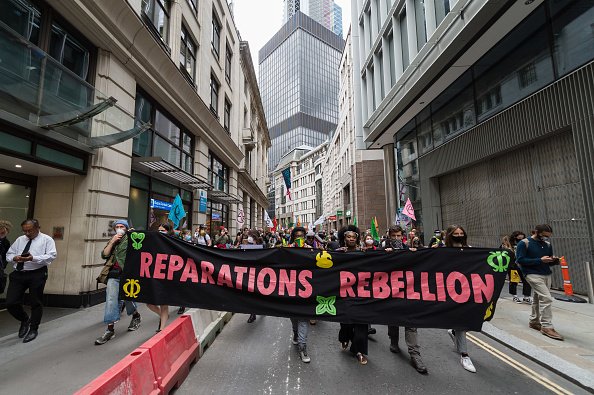

The transatlantic slave trade was an abomination and a shameful affront to human dignity, but for the last 200 years it has been a matter of national pride that Britain led the fight for abolition. Although claims for reparations are made against a number of Western democracies, it seems particularly ungracious for this country to be facing demands to pay trillions of dollars to cure an historic injustice going back centuries. Only a tiny minority of people in Britain today descend from ancestors who had any involvement in the slave trade so the suggestion that the majority should be required to pay for wrongs done by others is problematic. Whatever we make of the moral case, however, the legal/historical case is non-existent.
The eye watering sums that first caught media attention were published in June 2023[1] as a follow-up to a symposium held in May 2021 to discuss claims for reparations. Attendees at the symposium were told that they were “…engaged in perhaps the broadest and deepest ever examination of the legitimacy of demands for reparations for the crimes of colonialism, the transatlantic slave trade and chattel slavery”[2] so it is entirely appropriate to test the rigour of that “examination”, given the profound social consequences that the demands would have if they were ever implemented.
The first thing to understand is that neither the report nor views expressed at the symposium represent legally binding findings of any recognised body of International Law; they have no force or authority anywhere in the world and were merely the opinions of the very few individuals who were invited to speak. The issues were not debated and nobody was invited who might have challenged the arguments, which might be said to have been a missed opportunity. The only result of the symposium was to polarise opinion along predictable lines – those seeing an opportunity to enrich themselves at the expense of others being enthusiastic in their support for reparations, and those governments being targeted in a funk about the reaction they would get from voters asked to pay for a harm they did not cause.
The big surprise is that those arguing for reparations define slavery rather narrowly, distinguishing a legitimate slavery carried out by Africans and Arabs for millennia in Africa in respect of which no reparations are sought, from unlawful slavery which was pretty much anything with which Europeans were ever remotely connected. The original abolitionists of the 18th and 19th centuries made no such distinction, seeing chattel slavery (the practice of treating people as property) as the fundamental evil because it gave rise to such an infinite variety of terrible abuses, including those of the middle passage. Defining the evils of slavery narrowly by reference to the consequences it had for just one specific section of humanity – those transported across the Atlantic over a comparatively short period – enabled all speakers to overlook millennia of abuses that accompanied chattel slavery in Africa. It is an insult to those who experienced the horrors of slavery on the continent throughout the 19th century[3] and indeed to those who continue to suffer from it.
The symposium was told that the legal case made for reparations rested on two central arguments: firstly that there was a slave trade carried on in Africa that was lawful before Europeans came along, and secondly, that the practices of the slave trade introduced by Europeans were always unlawful under International Law. In support of the first argument it was said that the only “…legally permissible means of enslavement were restricted to captivity, self-bondage, punishment for certain crimes and, in some societies, inheritance of servile status…What was common and legal in Africa was the exchange between sovereigns of small quantities of criminals or captives from so-called “just wars”…This is also what African Rulers were consenting to when the first Europeans came to Africa to acquire slaves.”[4]
That’s OK then, and if only the Europeans had confined themselves to buying men captured in just wars between tribes, presumably nobody could possibly have objected. But how can we say with any confidence that African tribal chiefs in the 16th century gave any thought to the morality of slavery or vexed themselves overmuch about “just war” theory before carrying out their violent raids on their neighbours? Bear in mind they left no written records. It was taken for granted by the symposium but nowhere explained.
However, the suggestion from one speaker that Africans never carried out cruel tortures on their slaves for minor infractions[5] is certainly not born out by the evidence – “Last night a little native girl was hanged up by the arms until she died because she had been stealing fish and the men (Zanzibaris) just finished her off without a judge or jury”.[6] Holding up sub-Saharan Africans as models of peaceful co-existence and pioneers of the rule of law flies in the face of all the evidence which shows that legal rules were introduced by Europeans precisely to give some measure of protection to societies that were controlled by oppressive rulers and had no legal systems of their own. The sad truth is that humans everywhere have behaved appallingly towards other humans throughout history and probably always will. The countless numbers of Africans actively involved in the slave trade over many centuries were no exception.
The second argument, that under European law of the time slavery was unlawful, is, if anything, even less carefully articulated, perhaps because attendees at the symposium were being urged to look at the issues “from a perspective in this case that is consciously non-Eurocentric but rather committed to science and the search for the truth”,[7] although the purpose of the exercise is surely undermined if most of the available evidence is ignored. Patrick Robinson, a former Judge at the International Court of Human Rights put the case thus “A second basis for concluding that TCS (transatlantic chattel slavery) was unlawful is that it breached a normative principle of humanity which called for respect of the inherent dignity and personhood of all human beings, including Africans. This principle is recognized in the 1814 Treaty of Ghent, between Britain and the USA, both slaveholding States, as well as the 1815 Vienna Declaration, adopted by eight European states, including Britain, France, Spain and Portugal, all slaveholding States.”[8]
Leave aside the fact that by 1814 Britain had outlawed the slave trade and was well along the way to a total ban on slavery, the Treaty of Ghent in 1814 said nothing about the inherent dignity and personhood of all human beings. This was the treaty that, as historians will recall, brought hostilities to an end between Britain and the USA and defined the Canadian border. Far from being a universal proscription of slavery, it recognised the fact of its existence and the two signatory states merely undertook to use “best efforts” to bring it to an end, effectively acknowledging the limitations on what one sovereign state could enforce against another. Non-signatories gained no rights under the Treaty.[9]
Contrary to the bold assertion that relevant principles of international law existed before European lawyers defined them, they did not. There was no legal authority from 1596 that “ruled that chattel slavery was incompatible with English Law”[10] and even the much-quoted Somerset case of 1772 did not in fact declare it to be illegal.[11] The guiding principle for law and order (then as now) was that everything was legal unless specifically prohibited and although it is true that 18th century English attitudes towards chattel slavery often appear contradictory, this was because the law was in a state of development and would not be settled until the early 19th century. It is a complete misreading of the evidence to conclude that the legal position any earlier was that slavery was unlawful.
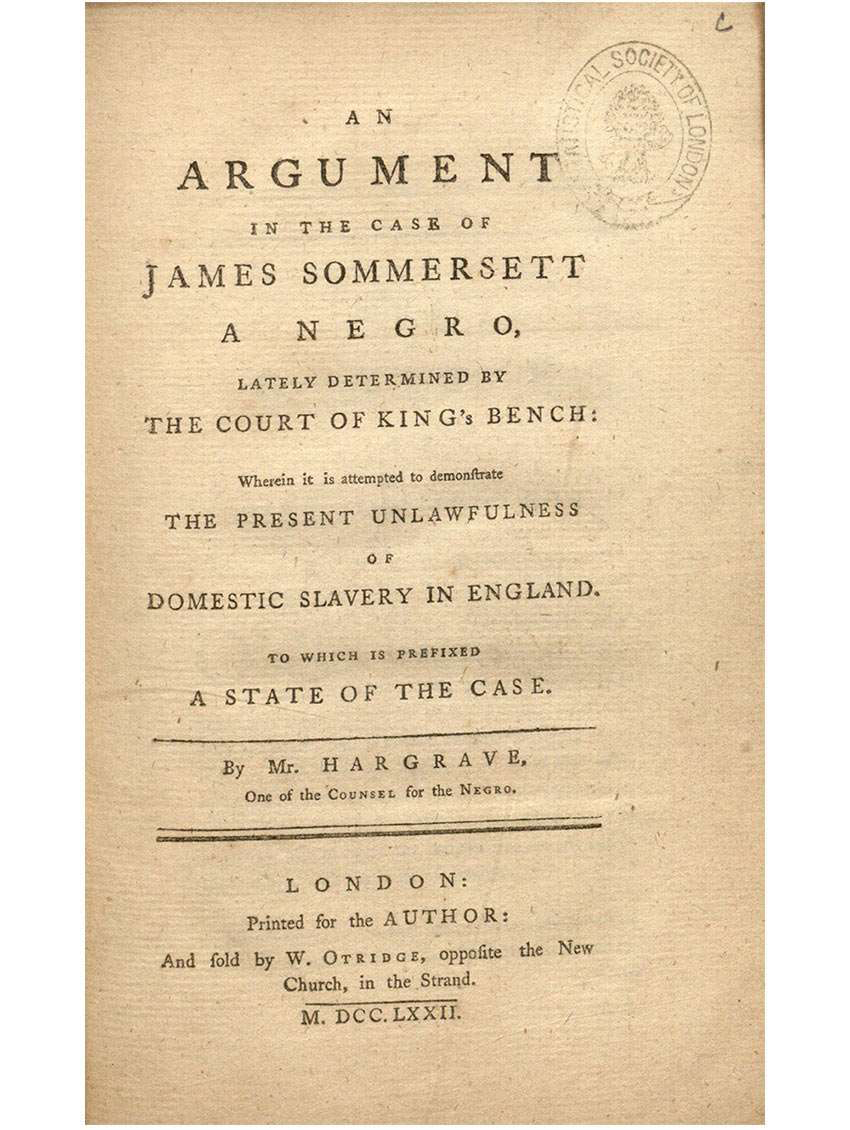
The lawyer Francis Hargrave’s ‘An Argument in the case of James Somersett, A Negro, lately determined by the court of King’s Bench’, 1772
It is hardly surprising that speakers were confused when one could mistake a comment from Elizabeth I for a legally enforceable prohibition[12], but to state with confidence that the basic torts law rule to be found in every legal system is that “You do not need to breach a specific obligation or specific prohibition in order to be responsible for the torts that you cause to another person”[13] when this has never been the position under English law, suggests a troubling lack of intellectual rigour. Still, since the same speaker demanded that payment of reparations should be discussed even before resolving the issue of its legal status, she may have failed to appreciate how legal claims ought to be properly articulated.
I could go on. Slavery was and is abhorrent and inexcusable in all its forms. The British attitude towards it has been consistent for two centuries, but those arguing for reparations know differently – apparently believing that black lives only matter when they are no longer in Africa itself.
There are of course huge impediments to any legal claim, not the least of which are identifying the proper parties to any claim, jurisdiction, limitation, causation and calculation of loss, but the case for historic reparations must be far more rigorously debated before it can be taken seriously.
Marcus Rutherford
[1] Report on Reparations for Transatlantic Chattel Slavery (TCS) in the Americas and Caribbean published by the Brattle Group in 2023 can be found at https://www.brattle.com/wp-content/uploads/2023/07/Report-on-Reparations-for-Transatlantic-Chattel-Slavery-in-the-Americas-and-the-Caribbean.pdf
There are some fundamental problems with the approach taken to the calculation of “loss” which are beyond the scope of this article.
[2] Gay McDougall, former member UN Committee on the Elimination of Racial Discrimination, introducing the second session of the First International Symposium on the Lawfulness of Transatlantic Slavery held on 20 -21 May 2021. The proceedings of the symposium can be found at
https://www.asil.org/sites/default/files/reparations/2021%20Reparations%20Proceedings.pdf
[3] Slave ownership has been a feature of African commerce for well over 2000 years. Saudi Arabia only finally abolished it in 1962 and it remains a concern in parts of Africa to this day. Industrial-scale transportation of slaves across the Atlantic was at its worst during the 18th century – still a long period, but a fraction of the overall time frame.
[4] Nora Wittman – Independent scholar and author of “Slavery Reparations Time Is Now: Exposing Lies, Claiming Justice for Global Survival – An International Legal assessment” p34 of the ASIL proceedings.
[5] Nora Wittman – she asserted of torture and other abuses “…All of that was totally unknown in Africa…” p33 of the ASIL proceedings.
[6] Dr Parke’s diary entry for 7 September 1888 – the original is in the RCSI Heritage Collections, Dublin. There are countless eyewitness accounts evidencing the terrible cruelties of the African slave trade and Dr Livingstone and others continued to campaign against it right up to the beginning of the20th century.
[7] Nora Wittman p33 of the ASIL proceedings.
[8] Introduction to the Brattle Report
[9] The Treaty mentions slaves twice. First, in connection with an obligation by each signatory to return property (including slaves) seized from the other, and the second recording best efforts to bring slavery to an end. The USA also ignored another “obligation” to protect the rights of native American Indians.
[10] Nora Wittman p 36 of the ASIL proceedings. She has the date wrong, but was referring to a law report from 1637 [In the matter of Cartwright, 11 Elizabeth: 2 Rushworth’s Coll 468] that mentioned in passing a case from 1569 in which the judge had referred to slavery in terms which did not suggest it was illegal, but that it was morally wrong within England. The case never set a precedent and is not considered good law.
[11] Somerset -v- Stewart (1772) 98 ER 499. Lord Justice Mansfield decided the limited point whether a slave could be forcibly removed from England for sale in Jamaica. He was not deciding whether the condition of slavery itself was illegal.
[12]Nora Wittman p36 of the ASIL proceedings
[13] Mamadou Hébié, Associate Professor of International Law at the Grotius Centre for International Legal Studies
Marcus Rutherford was born in East Africa and is a former International Disputes lawyer working in the City of London (now retired). He is currently writing an account of the Emin Pasha Relief Expedition (1887- 1890) sourced from the original diaries, notebooks and letters of the people involved.


